
Nuts-and-Bolts Spacecraft?
Updated: Mar 10

Nuts-and-Bolts Spacecraft? ―Jay Zinn
“The highest heavens belong to the Lord, but the earth he has given to man.” ―Ps 115:16
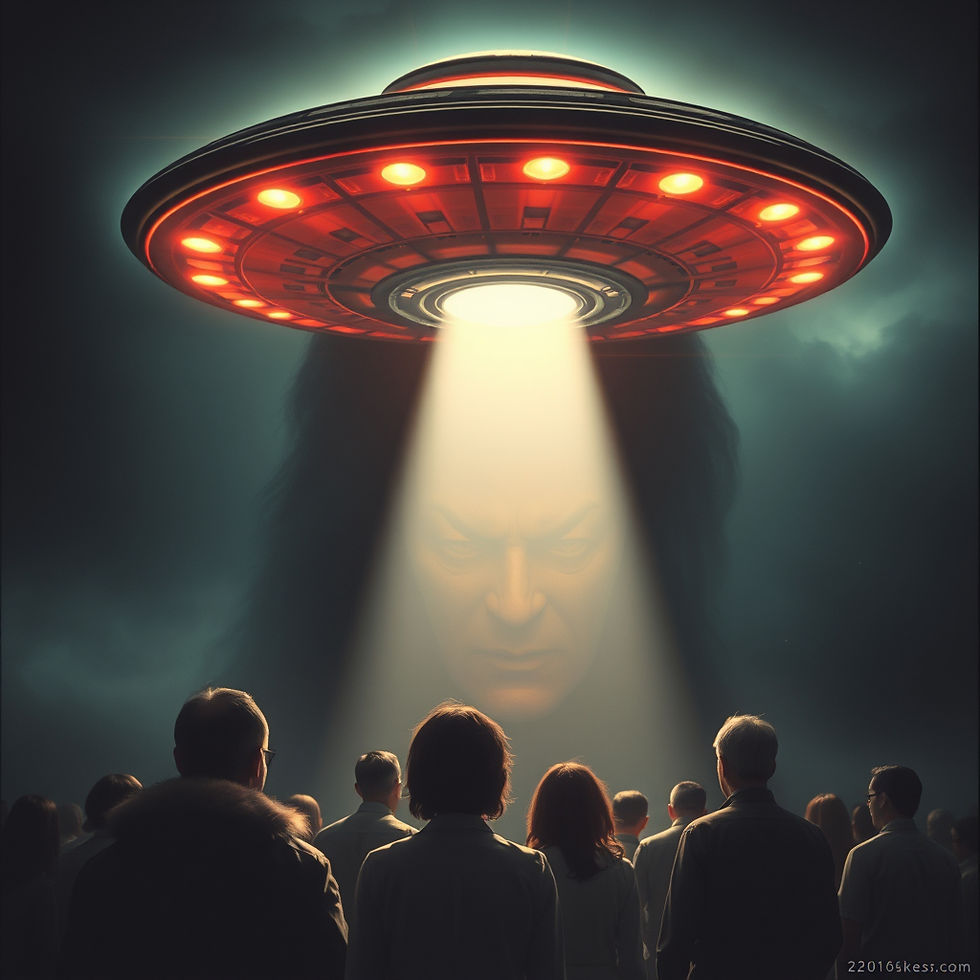
FOR THE BETTER PART OF A CENTURY, people have been seriously looking into UFOs—or UAPs, as they’re often called now—and after all that time, the conversation really boils down to three theories.
First, there’s the classic alien theory that I grew up with: the objects people are seeing are real, physical spaceships, built with nuts-and-bolts technology by beings from another planet, or maybe even another galaxy.
Then there’s the idea that these things aren't physical at all. Instead, they might be psychic projections, images bubbling up from a shared human consciousness. So, what people see is a very real experience, but it comes from inside our own minds, not from outer space.
The third theory is that they come from another dimension—a parallel reality that shares our same space but is usually invisible to us. The beings or things from this "other world" can pop into our reality whenever and however they want, and then just as quickly vanish.
Each theory tries to explain the same bizarre reports of aliens, abductions, and UFO sightings, just from completely different angles. There's not enough time to get into the weeds on all three, so let's start this blog with the one everyone knows: the theory that UFOs are actual spacecraft from other worlds.
When scientists consider the possibility of aliens visiting us, they're asking two questions: Is it likely that life exists on other planets? And if it does, could it actually travel all the way here?
Engineers and experts in aerospace, astronomy, and astrophysics who research UFO phenomena argue that when you really look at what's required for life during such an intergalactic trip, the odds of either of those things happening by chance are so slim that UFOs almost certainly aren’t physical ships from some other star system.
First off, the universe itself seems to be "fine-tuned" for "us" and us alone. The fundamental rules of nature—gravity, the strong and weak forces, the amount of matter in the cosmos—all have to be dialed in with incredible precision. If you tweaked any of them even slightly, you wouldn't just get a different universe; you'd get a dead one. No stars, no chemistry, no life.
Even within this perfectly balanced universe, our own little corner of it is a cosmic lottery win. It’s like we're in a quiet neighborhood in our galaxy. Our sun is a stable, long-lasting star—a rarity. Earth orbits at the perfect distance for liquid water, and it has the right gravity, spin, tilt, magnetic field, atmosphere, and even a large moon to keep us stable. Change any one of those things, and life as we know it would be impossible.
The experts say that when you start calculating the odds of all that lining up by pure chance, you end up with a number so small it's basically zero. Even with trillions of galaxies and countless planets, the math suggests there's only about a one-in-a-hundred-million chance of even a single planet like ours existing anywhere.[1]
And yet, here we are. Scientists who are honest and keep an open mind see that as a powerful hint of intelligent design, not just a lucky accident.
The argument goes deeper, looking at life itself. The sheer amount of complex, ordered information packed into a single cell, especially in our DNA, is staggering. It's far more complex than anything the non-living universe could ever cook up by randomly bumping particles together. In DNA, the sequence is everything; scramble the code, and it stops working. That kind of specific, complex information doesn't look like an accident. It looks like it was designed by a Creator, because a purely physical universe shouldn't be able to generate that much new, meaningful information on its own.
So, what does all this have to do with UFOs? Well, if it’s already a miracle that “one” life-bearing planet exists by chance, it's an even bigger stretch to believe another one is out there, close enough to visit, with intelligent beings who've mastered interstellar travel.
On top of that, the sightings themselves are just weird. UFOs don't behave like physical machines. People report objects that appear on camera but not to the naked eye, or vice versa. They change shape, size, and color in an instant. They make impossible right-angle turns at hypersonic speeds without a sonic boom, have no visible means of propulsion, and never seem to leave any wreckage behind. Despite thousands of sightings, we still don't have a single, undisputed piece of alien hardware to study.
If these were real ships, you'd expect to see some consistency, find physical debris, or detect their communications. You'd expect them to follow the laws of physics, even with advanced tech. Instead, the whole phenomenon feels slippery, inconsistent, and almost dream-like.
When all the scientific evidence is taken together, the conclusion seems pretty clear: the universe and life on Earth seem intentionally set up for us,[2] far too complex to be a random fluke. This points toward a Creator. Given that, and given how strangely UFOs behave, they probably aren't ships from another planet. They're likely something else entirely—something not quite physical, and of a very different origin.[3]
[1] Isaiah 45:18―For thus says the LORD, who created the heavens, who is God, who formed the earth and made it, who has established it, who did not create it in vain, who formed it to be inhabited: I am the LORD, and there is no other.
[2] Psalm 115:15―The highest heavens belong to the Lord, but the earth he has given to man.
[3] Klaus Schiessel & Hugh Ross―UFO's: A Demonic Deception, Their Origin and Purpose, 2018.


Comments